

| WHB Home : All Blogs : Recent Blogs : Early Church Literature - 7/12/2008 | |
 July 12, 2008 10:23pm v.10
Rating:
July 12, 2008 10:23pm v.10
Rating:


 Status: Hidden
| Leave a comment: no comments ~ | Printable Version |
| PREV | 368 of 459 | NEXT |
I'm reading the Apostolic Literature by Polycarp, Clement, Papias, Tertullian, and also some pseudepigrapha such as the Epistle of Barnabas. The Apostolic Fathers are the disciples of the New Testament writers that didn't receive the divine revelation bestowed on the 12 and the 70. Sadly, few people read the myriad of writings left behind by the Apostolic Fathers or any of the Early Church Fathers because few have even read the entire bible straight-though. I don't recommend reading any of these writers unless you've read the entire bible and have a good understand of what is in it, otherwise the later writings won't make any sense. Today, I read Polycarp's "Epistle to the Philippians" and the alleged Epistle of Barnabas. Here's a sample page:
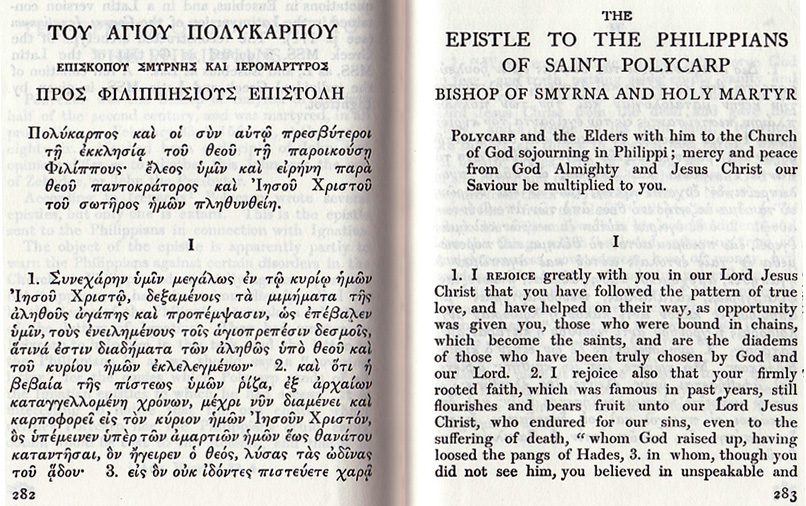 I heard that the Early Church and Apostolic Father's quoted the bible over a million times, and its also possible to reconstruct the entire thing based on their writings. Unfortunately, they make many mistakes because they are mere men like you and I who were witnesses of people who knew Jesus. Polycarp was a disciple of the disciple John (like Irenaeus and Papias) and I don't know if he knew Paul, but polycarp quotes the pauline body extensively in his epistle. This is what Polycarp says about Paul: "For neither am I, nor is any other like me, able to follow the wisdom of the blessed and glorious Paul, who when he was among you in the presence of the men of that time taught accurately and steadfastly the word of truth, and also when he was absent wrote letters to you, from the study of which you will be able to build yourselves up into the faith given you." ~ Polycarp to the Philippians 3:2 Polycarp's letter is short, and I read it in under twenty minutes. It's interesting that he has a compassionate introduction to the Church in Philipi as Paul does in all his letters. Polycarp was the bishop of Smyrna and wrote to Philipi concerning an elder who had "shipwrecked" his faith and I believe was excommunicated, and Polycarp encouraged them to have compassion on him and long for his repentence. It contains many quotations from Pauline epistles as well. Most of them were unreferenced but I could easily find the references. The second purpose of the letter was to include the writings gathered by ignatius (Another Apostolic Father). I also read the pseudepigrapha called the "Epistle of Barnabas." This epistle was even included in the canon temporarily by some churches. It is a valuable document for it goes through many events in the Torah (the five books of moses) and explains who each law is a typology of christ. It has 21 short chapters. I enjoyed it because his old testament hermeneutic is the same way that I read the Old Testament (through typologies). A memorable antecdote was when "Barnabas" says that Ezekiel 11:19 "replace my heart of stone with one of flesh" referred to how Jesus' covenant in his fleshly body was greater than the stone tablets of Moses. Although he may have stole this idea from Paul (2 Cor 3:3). The translation I used for Barnabas and Polycarp was: Apostolic Fathers I by Kirsopp Lake.
Last Update: July 12, 2008 11:06pm |
| PREV | 368 of 459 | NEXT |
| Leave a comment: no comments | [Hide Comments] | Printable Version |
| BACK TO COLUMNS | ©2026 http://www.houtz.tv by Wyatt Houtz | LOGIN |