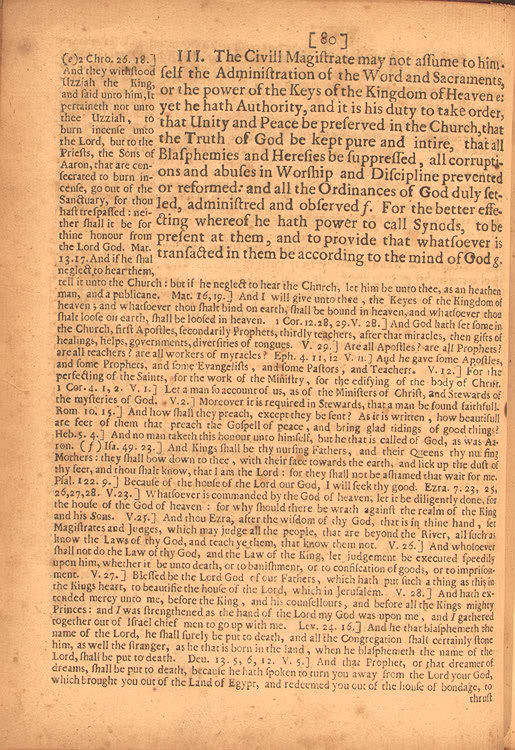
) is the most well known and respected of all the Reformed Confessions, although whether it is the best is contested by the
and others. The Westminster Confession (WCF) stands in the tradition of John Calvin's Institutes, and John Knox's Influence on Scotland, England and the Church of England (Anglican Communion). It is still used by most confessional reformed churches, but usually it has been slightly modified; for example, the PCA removed the WCF's statement about the Pope being the Anti-Christ and the Prohibition against marrying your wife's relatives after her death etc. (
Here is the Presbyterian Church of America's statement on the WCF and their modifications.)The Baptist London Confession of Faith (1644) was completed a few years before the WCF was finished, and is very similar to the WCF except for its insistence on credobaptism (believers baptism) instead of padeobaptism (infant baptism). The Mr. Spurgeon's Confession of Faith was not actually written by Charles Spurgeon but recommend by him as an alternate to the WCF; He was a Reformed Baptist and the first megachurch pastor.
So what do I think about the Westminster Confession?
Overall, I agree with the whole thing. Surprised? Well, I am writing a blog about it. There are a few things about it that I don't think are ideal but if interpreted correctly, then I agree with the whole thing. The WCF is also printed at the end of Wayne Grudem's "Systematic Theology" -- a contemporary book that may be regarded as a modern-day Reformed Baptist Confession and Catechism. Wayne Grudem also says that he agrees with the WCF and it summaries his overall position represented in his Systematic Theology.
I live in a contradiction, where I think its fine for other people to baptize their infants but I am waiting for my children to give a confession of faith, because its difficult for me to understand how I may baptize my children but not give them communion. Although I believe that John Calvin's arguments in Book IV of his Institutes may be the solution. So naturally, when I read the WCF Chapter 28, Section 6, I stumbled. Here it is in entirety:
WCF Chapter XXVIII Section VI. The efficacy of baptism is not tied to that moment of time wherein it is administered;(John iii. 5, 8.) yet, notwithstanding, by the right use of this ordinance the grace promised is not only offered, but really exhibited and conferred by the Holy Ghost, to such (whether of age or infants) as that grace belongeth unto, according to the counsel of God's own will, in his appointed time.(Gal. iii. 27; Tit. iii. 5; Eph. v. 25, 26; Acts ii. 38, 41.)
So I did some research and R.C. Sproul informed me that the WCF was written against the Roman Catholic's doctrine of baptism, which implied that baptism washed away original sin, and then had to be supplemented to maintain a state of justification. So if you read the scriptural proofs, its clear that the WCF divines were writing against the Roman Church. So basically, R.C. Sproul interprets baptism in the WCF as a one time event that applies to the entire life of the believer, not just to the moment when the Christian is baptized, such that the Christian's baptism doesnt wear off. So if you retrospectively apply this to infants, than the washing does cover their whole life. Some people have explained to me that baptism of infants doesn't mean anything until the child gives a confession of faith later in life, which seems to be against the testimony of scripture that baptism is a sign and seal of regeneration, or death and resurrection in Christ. So I don't know how you can be baptized and it doesn't symbolize new life. So I still have some questions.
Furthermore, I have some questions on the WCF's interpretation of the Law and Covenants. Although I agree with it, I do believe that there may be better ways of describing the relationship of Israel to the Church, the Old Testament to the New Testament, the Old Covenant to the New Covenant. I also think its a stretch to say that Adam had a covenant in the garden, even though Hosea 6:7 says that Adam broke the covenant. Also, the implications about Noah and David's covenants do not seem to perfectly fit in this model.
Over all to a complete confession of faith, I don't know of anything that is more accurate, especially as a whole to scripture than the Westminster Confession of Faith. If you haven't read it, go do it now!
Last Update: November 21, 2009 7:25pm


 November 21, 2009 6:56pm v.8
Rating:
November 21, 2009 6:56pm v.8
Rating:

 Status: Hidden