

| WHB Home : All Blogs : Recent Blogs : Gospel and law: Contrast or continuum? (Review) - 4/8/2009 | |
 April 2, 2009 6:12pm v.10
Rating:
April 2, 2009 6:12pm v.10
Rating:

 Status: Hidden
| Leave a comment: 1 comments ~ | Printable Version |
| PREV | 403 of 459 | NEXT |
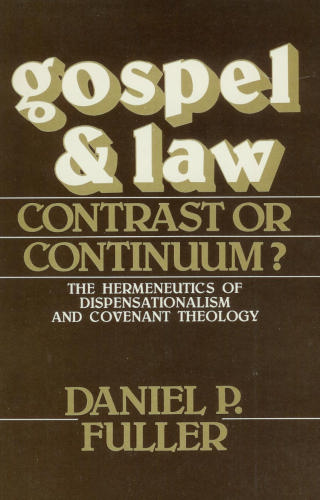 I highly recommend Daniel P. Fuller's book, Gospel and law: Contrast or continuum? : The hermeneutics of Dispensationalism and Covenant Theology. I discovered Daniel Fuller through John Piper's article, "Books That Have Influenced Me Most". I tremendously admire John Piper, and have benefited greatly from his writings as well as from the authors that influenced him, particularly Jonathan Edwards, George Eldon Ladd, and now Daniel P. Fuller. John Piper was a student of Daniel Fuller at Fuller Theological Seminary. Daniel Fuller is not as well known as his father, Charles E. Fuller, who founded Fuller Theological Seminary. I highly recommend Daniel P. Fuller's book, Gospel and law: Contrast or continuum? : The hermeneutics of Dispensationalism and Covenant Theology. I discovered Daniel Fuller through John Piper's article, "Books That Have Influenced Me Most". I tremendously admire John Piper, and have benefited greatly from his writings as well as from the authors that influenced him, particularly Jonathan Edwards, George Eldon Ladd, and now Daniel P. Fuller. John Piper was a student of Daniel Fuller at Fuller Theological Seminary. Daniel Fuller is not as well known as his father, Charles E. Fuller, who founded Fuller Theological Seminary. What is the different between Gospel and Law? How were the Israelites saved under the Law compared to how Christians are saved under grace? How you answer these questions, determines how you interpret key verses like Romans 9:30-10:4 and Galatians 3:10-29. Dispensationalism teaches that Israel was saved by works of the Law and the Church is saved by Grace -- a total contrast. Covenant Theology teaches that ever since Adam, man has been saved by a Covenant of Grace, and only Jesus was saved by a Covenant of Works (or Law) due to the fall, but it is hypothetical that man could be saved by works still -- a duality. Daniel P. Fuller argues for a third and simpler solution that man has always been saved by Grace and has never been saved by works, and that the Mosaic Law was as much about Grace as the Church is today. I originally read Gospel and Law a few years ago as I wrestled with some of the problem with Dispensationalism. This book is primarily a polemic against the Dispensationalism, and claims that the modern form of Dispensationalism no longer is faithful to Darby's dichotomy of Law and Grace because Darby's suggestion that some men are saved by their own works. Now Dispensationalism teaches that all men are saved by Grace and Fuller even suggests that modern dispensationalism is just like Covenant Theology's two ways of salvation. So I think that every dispensational theologian needs to read this book. I reread this book this week because of some questions I have about Covenant Theology as well. Daniel Fuller analyzes all the passages that John Calvin claimed to show an obvious distinction between Law and Grace, and then Fuller argues that Calvin was incorrect to say that the Law is contrary to Grace. Full teaches that anyone who believed that they were saved by the works of the Law were damned, but those who pursued it in faith were saved; not by their works, but by faith in God's law that pointed forward to Christ. Daniel P. Fuller's arguments in this book are compelling and detrimental to Dispensationalism. Fuller considers himself basically adhering to Covenant Theology. His Unity of The Bible has outraged many Westminster people, who counter Fuller's claims by calling them a priori. I still have questions about Covenant Theology, and this short book has raised some concerns that Covenant Theology shares in some of the Law vs. Gospel problems that are ubiquitous in Dispensationalism. Is there really two ways to be saved? Or is it by grace alone?
Last Update: April 8, 2009 1:57pm |
| PREV | 403 of 459 | NEXT |
| Leave a comment: 1 comments | [Hide Comments] | Printable Version |
Comments: #1 April 10, 2009 5:55pm This was a good post. I always hold the grace model above any other, but the way in which we understand grace is paramount to our view of eschatology, soteriology, and even ecclesiology! Consider your comments in your second to last paragraph.
phil
| ||
| BACK TO COLUMNS | ©2026 http://www.houtz.tv by Wyatt Houtz | LOGIN |